
Free whitepaper
Pharma under threat
Counterfeit medicines poison vulnerable patients, and impersonations and lookalikes cause chaos in the pharma industry. Is your company’s online presence safe from harm?
Get the details in a free guide:
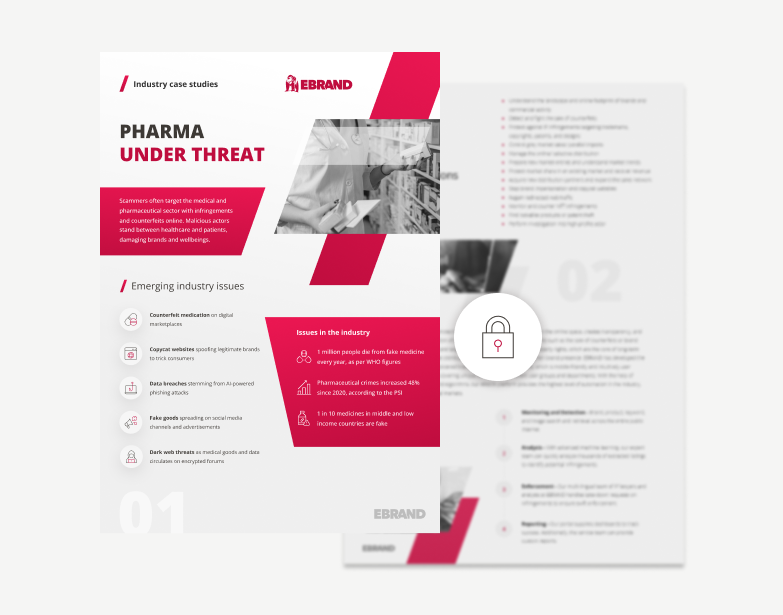
Get the guide above to uncover the latest threats to the pharma industry and your clients
As the WHO issues eye-opening stats about the amount of people dying from counterfeit medicines, it's time for brands to take control, and fight back against online counterfeiters and digital scammers.
Fake shops target the pharma industry, exploiting demand inelasticity and siphoning revenue from life-saving goods and services. Impersonators shatter the trust in reliable caregivers and name-brand providers.
Pharma companies can make a big difference with the right tools at hand. With EBRAND, organizations patrol their online landscapes, identifying and eliminating infringements before they scam clients and breach private information.
The guide above covers the following:
- The latest facts and trends from emerging industry threats
- Uncovering threats from copycat website to fake social media ads
- Unmasking cyberattacks and phishing campaigns that target confidential information
- Services like Brand Protection, Risk Protection, Cyber Threat Intelligence, and VIP and Executive Protection
Additional Resources
Pharma FAQs
Brand protection safeguards intellectual property, reputation, and customers in the pharmaceutical industry from threats such as fake shops, counterfeit goods, and fraudulent online retailers. Effective brand protection strategies cover online brand protection, brand protection software, domain monitoring, and marketplace monitoring.
Counterfeits and fake products appear on both small fraudulent sites and major platforms. Criminals use website scams, social media campaigns, and IP loopholes to sell illegal goods. Without strong monitoring, fake websites, fake domains, and website spoofing can quickly damage consumer trust and reduce revenue. Businesses in every sector, from fashion to pharmaceuticals, need a complete brand protection strategy to stop these threats.
Fake shops are fraudulent websites or fraudulent online retailers that copy medical products, trademarks, and imagery to deceive customers. Some operate as single-brand sites, while others act as grey markets or multi-brand marketplaces selling fake products. Criminals often use website spoofing or fake domains to appear authentic. Many design scams to avoid detection by using country-specific IP blocking or removing brand names from the domain.
These pharma infringements also appear on established platforms. Organizations across the industry need marketplace monitoring and social media impersonation protection as part of their brand protection software. Companies must act quickly to report counterfeit goods and carry out reporting counterfeit merchandise to shut down these operations before they cause serious damage.
To prevent ecommerce fraud, medical providers must monitor and enforce continuously. Companies should use online brand protection tools that include ecommerce fraud prevention, domain monitoring, and fraud online purchase detection. A strong programme targets fake shops, fake websites, and fake products across the entire digital environment.
With brand protection expertise or global resources, pharma businesses can remove fraudulent online retailers, disrupt grey markets, and delete counterfeit listings from marketplaces. The goal is to stop counterfeit sales and prevent them from returning. Partnering with a provider that delivers advanced brand protection software ensures ongoing defence, protects ecommerce growth, and keeps customer trust intact.
EBRAND’s ARGOS platform helps businesses protect themselves online. Delivering a suite of Online Brand Protection research tools and action channels, supported by teams of lawyers and analysts, ARGOS provides an intuitive, effective Online Brand Protection solution.
Buying medicine online is incredibly convenient but carries significant risks. Fake pharmacy websites sell counterfeit, expired, or dangerous products, and they often steal personal and financial data. With AI making scams more sophisticated, vigilance is crucial. Here is a step-by-step guide to determine if a pharmaceutical website is legitimate.
For consumers, the process begins with a careful inspection of the website’s basic information. First, check the domain name and URL for misspellings of well-known brands or unusual extensions like .shop or .info, which are uncommon for legitimate pharmacies. A real pharmacy must have a verifiable physical address and phone number within the country where it operates; you should be able to locate this address on a map and call the number. Legitimate sites will also always require a valid prescription from a licensed healthcare provider for prescription medications. Any site that allows you to purchase prescription drugs simply by filling out an online questionnaire without a doctor’s consultation is operating illegally and is a major red flag.
Next, you must thoroughly investigate the site’s reputation and security. Search for independent reviews on platforms like Trustpilot or the Better Business Bureau, but be skeptical of reviews only on the site itself, as these can be fabricated. A simple Google search of the website name plus the word “scam” or “complaint” can reveal crucial reports from other users. From a security standpoint, ensure the payment page is secure by looking for “https://” and a padlock icon in the address bar; never enter information on a site that only uses “http://”. Be extremely cautious of payment methods that are irreversible and untraceable, such as wire transfers, gift cards, or cryptocurrency. Legitimate pharmacies use standard, secure credit card processors.
For small businesses, entrepreneurs, and especially larger enterprises in the pharmaceutical or wellness space, the threat is different and requires a strategic defense. Manual checks are insufficient when facing large-scale brand impersonation, where fake online pharmacies not only steal customer revenue but also cause severe reputational damage and pose serious public health risks. The professional approach involves continuous monitoring for infringements using advanced tools that scan search engines, social media, and digital marketplaces for fake stores misusing your branding, logos, or product names. When fakes are found, gathering comprehensive evidence is key for successful takedowns; this includes documenting stolen branding, counterfeit product listings, scam domain registration details, and links to associated payment or social media accounts used in the fraud. Due to the complexity and scale, most companies partner with specialized brand protection experts. Solutions like those mentioned in the original text, such as EBRAND’s Online Brand Protection, automate the entire process of detection, monitoring, and executing legal takedowns at scale, which is essential for managing threats across multiple jurisdictions.
The best proactive step for any business in this sector is to understand the full scope of the threat. This often begins with a professional fake shop audit, which scans the internet to discover how many fraudulent stores are actively exploiting your brand. For consumers, the safest rule is to use only pharmacies verified by your national regulatory body, such as the VIPPS seal in the United States. While fake pharmaceutical shops are evolving, combining personal vigilance with professional protection tools is the most effective way to turn the tide and ensure safety.
EBRAND delivers the best Online Brand Protection Solution.
Effective online brand protection for pharmaceuticals and medical products requires a platform that actively monitors and mitigates key threats. It must secure market integrity and patient safety by detecting counterfeit medical listings, unauthorized sellers, and brand impersonation across websites, marketplaces, and social media. The solution should provide actionable intelligence, tailored to the strict regulatory landscape of healthcare, and support decisive enforcement to remove high-risk infringements.
To explore how a dedicated program addresses these challenges, get a free brand audit right here.
